1
/
of
1
Stanford / Howarth / Partington
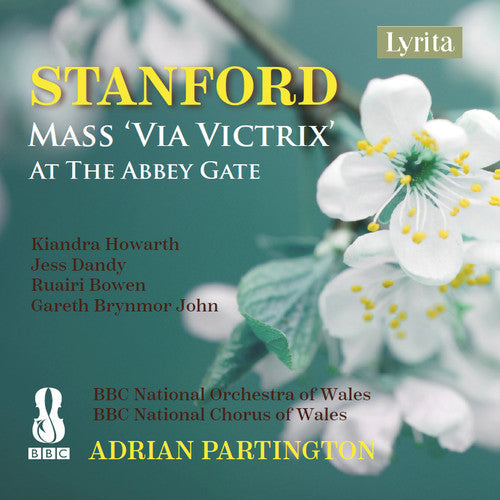
Stanford / Howarth / Partington: Mass Via Victrix - COMPACT DISCS
Regular price
$6.30 USD
Regular price
$0.00 USD
Sale price
$6.30 USD
Shipping calculated at checkout.
Quantity
Couldn't load pickup availability
Share
Title: Mass Via Victrix
Artist: Stanford / Howarth / Partington
Label: Lyrita
Product Type: COMPACT DISCS
UPC: 5020926038227
Genre: Classical
Release Date: 2019-05-03
Number of Discs: 1
In 1919 Stanford chose to compose a setting of the mass to commemorate the allied victory, hoping perhaps that the work might be attractive to choral societies. In terms of his music connected with the war, the Mass 'Via Victrix 1914-1918' Op. 173 would be his greatest and most substantial effort, and it would prove to be a canvas to equal similar large-scale choral tours de force such as his Requiem Op. 63 (1897), Te Deum Op. 66 (1898) and Stabat Mater Op. 96 (1907), all ambitiously conceived for chorus, four soloists, orchestra and organ. Bearing the adapted Latin dedication ('Transiverunt per ignem et aqua et eduxisti in refrigerium' ["(They) went through fire and water and thou has brought (them) into a wealthy place"?] taken from Psalm 66 verse 12 (from Tyndale's translation), the work was dedicated to those who made the greatest sacrifice in defence of their country. The mass was therefore intended as a work of thanksgiving, of celebration for the final victory, but equally one which looked into the heart of the nation, to commiserate with those who grieved, to pray for those whose sense of loss was unconsolable, and to urge for a spirit of renewal in the face of the hardships and sorrows the nation had had to endure. In this sense Stanford's work stood at the vanguard of other cathartic expressions of war grief such as John Foulds' A World Requiem (1921), Delius's Requiem (1914, but not performed until 1922) and Arthur Bliss's Morning Heroes (1930). When news was made known of the unveiling of the Cenotaph and the interment of the Unknown Warrior at Westminster Abbey in October 1920, the Right Hon. Mr Justice Charles John Darling (1st Baron Darling) published a poem 'At the Abbey Gate' in The Times on 26 October (under the initials C.J.D.) as part of a larger article 'To the Unknown Dead' announcing the special nature of the ceremony on 11 November. Through a desire to commemorate this major national occasion, Stanford decided to set Darling's poem as a march for chorus, solo baritone and orchestra. At the Abbey Gate Op. 177 was completed in November 1920 in the days following the great national ceremony.
Tracks:
Audio Sample:
All soundclips are provided by Tidal and are for illustrative purposes only. For some releases, the tracks listed may not accurately represent the tracks on the physical release.
View full details
Artist: Stanford / Howarth / Partington
Label: Lyrita
Product Type: COMPACT DISCS
UPC: 5020926038227
Genre: Classical
Release Date: 2019-05-03
Number of Discs: 1
In 1919 Stanford chose to compose a setting of the mass to commemorate the allied victory, hoping perhaps that the work might be attractive to choral societies. In terms of his music connected with the war, the Mass 'Via Victrix 1914-1918' Op. 173 would be his greatest and most substantial effort, and it would prove to be a canvas to equal similar large-scale choral tours de force such as his Requiem Op. 63 (1897), Te Deum Op. 66 (1898) and Stabat Mater Op. 96 (1907), all ambitiously conceived for chorus, four soloists, orchestra and organ. Bearing the adapted Latin dedication ('Transiverunt per ignem et aqua et eduxisti in refrigerium' ["(They) went through fire and water and thou has brought (them) into a wealthy place"?] taken from Psalm 66 verse 12 (from Tyndale's translation), the work was dedicated to those who made the greatest sacrifice in defence of their country. The mass was therefore intended as a work of thanksgiving, of celebration for the final victory, but equally one which looked into the heart of the nation, to commiserate with those who grieved, to pray for those whose sense of loss was unconsolable, and to urge for a spirit of renewal in the face of the hardships and sorrows the nation had had to endure. In this sense Stanford's work stood at the vanguard of other cathartic expressions of war grief such as John Foulds' A World Requiem (1921), Delius's Requiem (1914, but not performed until 1922) and Arthur Bliss's Morning Heroes (1930). When news was made known of the unveiling of the Cenotaph and the interment of the Unknown Warrior at Westminster Abbey in October 1920, the Right Hon. Mr Justice Charles John Darling (1st Baron Darling) published a poem 'At the Abbey Gate' in The Times on 26 October (under the initials C.J.D.) as part of a larger article 'To the Unknown Dead' announcing the special nature of the ceremony on 11 November. Through a desire to commemorate this major national occasion, Stanford decided to set Darling's poem as a march for chorus, solo baritone and orchestra. At the Abbey Gate Op. 177 was completed in November 1920 in the days following the great national ceremony.
Tracks:
Audio Sample:
All soundclips are provided by Tidal and are for illustrative purposes only. For some releases, the tracks listed may not accurately represent the tracks on the physical release.

You may also like
-
046: Legacy In Motion - Green Colored Vinyl - VINYL LP
Regular price $25.50 USDRegular price$0.00 USDSale price $25.50 USD -
2019 Dopo La Caduta Di New York / O.S.T.: 2019 Dopo La Caduta Di New York (Original Soundtrack) - VINYL LP
Regular price $13.79 USDRegular price$0.00 USDSale price $13.79 USD -
Abel Pintos: 11 - VINYL LP
Regular price $18.30 USDRegular price$0.00 USDSale price $18.30 USD -
The Virus: Vivo - VINYL LP
Regular price $21.60 USDRegular price$0.00 USDSale price $21.60 USD